
Interfaith Ketubahs: Celebrating Love and Unity
Share
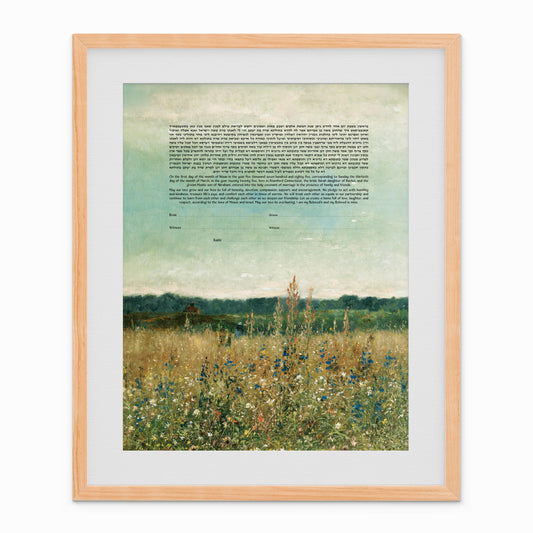
An interfaith ketubah allows a couple to include the Jewish tradition of a marriage document while choosing wording, languages, artwork, and signature lines that represent both partners.
Hebrew is not required, and one partner does not need to adopt a Hebrew name. Interfaith couples may choose English-only wording, Hebrew and English, or even three languages. The text can acknowledge the couple’s different traditions while focusing on the values and home they are building together.
Before finalizing the ketubah, couples should ask their rabbi or officiant to approve the wording and confirm exactly who will sign it.
What Is an Interfaith Ketubah?
A ketubah is a Jewish marriage document traditionally completed and signed before the wedding ceremony. Traditional ketubah texts describe the obligations created by the marriage.
Many contemporary couples choose wording that expresses mutual promises, shared values, and their vision for married life. An interfaith ketubah adapts this tradition for a couple in which one partner is Jewish and the other comes from a different religious, cultural, or family background.
There is no single interfaith ketubah text that is right for every couple. The wording may be Jewish-inspired, spiritual, egalitarian, secular, or written specifically for the couple.
Can an Interfaith Couple Have a Ketubah?
Yes. Many interfaith couples include a ketubah in their wedding ceremony.
A ketubah can allow one partner to honor an important Jewish tradition without asking the other partner to accept religious language or an identity that does not represent them. The couple can select wording centered on mutual love, responsibility, family, and respect for both backgrounds.
Requirements differ among rabbis and officiants. Some may have a preferred text or particular instructions about witnesses and signature lines. Couples should have the wording approved before the ketubah is printed.
What Does an Interfaith Ketubah Say?
Interfaith ketubahs commonly include commitments to:
- Love and respect one another
- Offer mutual support
- Communicate with honesty and compassion
- Build a peaceful and welcoming home
- Honor both families and backgrounds
- Share meaningful traditions
- Face life’s joys and difficulties together
- Pass shared values to future generations
“We honor the diverse traditions and beliefs that shape us, committing to a life of understanding, respect, and shared values as we build a loving and inclusive home together.”
One paragraph from WeddingKetubah.com’s interfaith textThis wording recognizes that the couple may come from different traditions without making those differences the entire subject of the document. The emphasis remains on their shared values and the home they are creating.
Couples may choose a complete existing text, request adjustments, or provide their own wording.
What If One Partner Does Not Have a Hebrew Name?
A Hebrew name is not required for an interfaith ketubah.
When one partner does not have a Hebrew name, our general practice is to write that person’s existing name phonetically in Hebrew letters. For example, someone named Michael remains Michael. We do not automatically change the name to the traditional Hebrew name Michoel.
Our goal is to be inclusive without imposing a Hebrew or religious identity that the person has not chosen.
There can be exceptions based on the couple’s preference or the officiant’s instructions, but the normal approach is to transliterate the person’s real name rather than assign a new one.
Does an Interfaith Ketubah Need Hebrew?
No. An interfaith ketubah may be written in:
- English only
- Hebrew and English
- Hebrew and another language
- English and another language
- Three languages
However, based on WeddingKetubah.com interfaith orders, approximately 95% of the interfaith ketubahs we prepare include both Hebrew and English.
Many couples feel that Hebrew honors the Jewish origins of the ketubah, even when one partner does not speak Hebrew or have a Hebrew name. Writing that partner’s name phonetically in Hebrew allows the document to retain its connection to Jewish language and tradition without changing the person’s identity.
The Hebrew and English sections do not always need to be word-for-word translations. They may express similar commitments in language that reads naturally in each language.
Can an Interfaith Ketubah Include Three Languages?
Yes. Some couples want a third language to represent another partner, family, or cultural background.
WeddingKetubah.com has prepared three-language ketubahs incorporating languages including:
- Arabic
- Spanish
- French
- Indian languages
When a couple requests a language that we do not translate, they must provide the final approved translation. We use a properly licensed font that supports the language clearly and accurately.
Adding another language requires more than simply inserting an extra paragraph. The designer must consider:
- The amount of available text space
- The relative length of each language
- The direction in which the language is read
- Font compatibility
- Letter size and legibility
- The balance of the overall layout
Couples interested in three languages should make that decision before the proof is designed. Adding an entire language after the layout has been completed may require substantial changes.
Can We Write Our Own Interfaith Ketubah Text?
Yes. Couples may select a prepared interfaith text, modify existing wording, or provide completely original text.
Personalized wording may include:
- Mutual vows
- A description of the marriage the couple hopes to build
- Promises concerning family and home
- References to both traditions
- A meaningful quotation
- Commitments about holidays or family customs
- Values the couple hopes to pass to their children
A longer text is not always a better text. The wording must fit comfortably within the chosen artwork while remaining large enough to read.
Couples should ask their officiant to review the final wording before approving the proof.
Standard or Personalized Interfaith Text
Couples generally choose between a standard text and a personalized ketubah.
Standard text
A standard ketubah contains prepared wording with blank spaces for the couple’s details. Those details may be completed by hand before the ceremony.
This can work well for couples who are comfortable with the existing wording and do not need customized languages, names, or signature lines.
Personalized text
A personalized ketubah may include:
- The couple’s names
- Hebrew names or phonetic Hebrew spellings
- Wedding date
- Hebrew date
- Ceremony location
- Selected or custom wording
- Multiple languages
- Customized signature lines
WeddingKetubah.com provides a digital proof for personalized orders before printing. The couple can review the spelling, wording, layout, dates, and signature lines and request corrections before approving the final version.
Who Signs an Interfaith Ketubah?
There is no universal signature format for every interfaith ceremony.
An interfaith ketubah may have lines for:
- Both members of the couple
- Two witnesses
- A rabbi
- A cantor
- A priest or minister
- One or more officiants
- Additional witnesses or family members
Many modern interfaith ketubahs include lines for the couple, two witnesses, and an officiant. However, the exact arrangement depends on the ceremony.
We have prepared ketubahs with one signature line labeled Rabbi and a separate line labeled Priest. We can also include two general officiant lines when that is more appropriate.
Couples should confirm the exact titles. Rabbi, cantor, priest, minister, and officiant are not interchangeable labels.
Before the proof is prepared, ask:
- Will both partners sign?
- How many witnesses are needed?
- Will one or two clergy members sign?
- What title should appear below each line?
- Does the officiant have requirements regarding who may serve as a witness?
Incorrect or missing signature lines are among the easiest problems to prevent and the most frustrating to discover shortly before the wedding.
Choosing an Interfaith Ketubah Design
An interfaith ketubah design does not need to represent every part of both partners’ backgrounds. It should feel meaningful to the couple and be something they will enjoy displaying after the wedding.
Some couples want visible Jewish imagery. Others prefer artwork based on nature, family, peace, growth, or continuity.
Bombay, India, 1911
Our reproduction of a ketubah created in Bombay, India, in 1911 is frequently chosen when one partner is Indian or descended from an Indian family.
For those couples, the historical location gives the artwork a direct connection to family heritage. It is more than a decorative design; it can connect the marriage document to a place that is part of the couple’s story.
Black-and-white Tree of Life
A black-and-white Tree of Life can work especially well for a couple seeking a design that is meaningful across traditions.
Trees can represent:
- Family
- Shared roots
- Growth
- Continuity
- Strength
- The life a couple is building together
The symbolism is familiar without belonging exclusively to one denomination.
Olive branches
Olive branches are widely associated with peace and reconciliation. They appear in Jewish and Christian traditions and are also recognized as a universal symbol of peace.
An olive-branch ketubah can therefore express a meaningful idea without making one religious tradition visually dominant.
Grapevines
Grapevines can symbolize connection, abundance, nourishment, and celebration. Vine imagery has meaning in both Jewish and Christian traditions while also working naturally as botanical wedding artwork.
The Four Seasons
A four-seasons design can represent enduring love through the changing stages of life.
This theme is particularly appropriate for secular, humanist, nature-focused, or interfaith couples who want meaningful symbolism without explicit religious imagery.
Sunset and ocean designs
Sunset and ocean artwork offers a universal theme based on natural beauty, transition, and the feeling of something larger than ourselves.
These designs are often a natural fit for beach weddings, destination ceremonies, and couples who prefer artwork without specific religious symbols.
Couples can view our interfaith ketubah designs, including historical, floral, nature-inspired, traditional, and contemporary artwork.
Interfaith Couples and Jewish Wedding Traditions
Including a ketubah in an interfaith wedding is not unusual. New York Knicks player Jalen Brunson and his wife, Dr. Ali Marks-Brunson, incorporated Jewish traditions into their 2023 wedding, including signing a ketubah and marrying beneath a chuppah.
Their wedding is one public example of how a couple can include meaningful Jewish customs in a ceremony that reflects their own relationship.
The important point is not to copy another couple’s ceremony. Each couple should decide which traditions feel honest and meaningful to them.
Questions to Ask Your Rabbi or Officiant
Before ordering a personalized interfaith ketubah, ask:
- Do you have a preferred ketubah text?
- May we modify the wording?
- Does the ketubah need to include Hebrew?
- Who should sign it?
- How many witness lines are required?
- Should the clergy line say Rabbi, Cantor, Priest, Minister, or Officiant?
- Will more than one officiant sign?
- Will the ketubah be read during the ceremony?
- Are there religious statements that should be included or avoided?
When two clergy members are involved, both should review the wording and signature format before printing.
Is an Interfaith Ketubah Legally Binding?
A ketubah is generally used as a religious, ceremonial, and personal wedding document. It does not replace a civil marriage license.
Whether any wording in a ketubah could have legal significance depends on the document and the laws of the relevant jurisdiction. Couples seeking an enforceable legal agreement should speak with a qualified attorney rather than relying on the ketubah alone.
Framing and Preserving the Ketubah
Many couples frame their ketubah after the wedding and display it in their home.
To protect it:
- Allow the signatures to dry completely before handling or framing it.
- Keep the ketubah flat and clean.
- Use archival framing materials.
- Avoid permanent glue or mounting methods.
- Keep it away from direct sunlight and excessive moisture.
- Confirm the exact finished dimensions before purchasing a frame.
The design should therefore be selected not only for the wedding day, but also as a piece of artwork the couple will want to live with for many years.
Common Questions About Interfaith Ketubahs
Can the non-Jewish partner sign the ketubah?
Yes, in many interfaith and modern ceremonies both partners sign. The final format should be confirmed with the officiant.
Can an interfaith ketubah be English only?
Yes. Hebrew is not required for every interfaith ketubah, although most of the interfaith ketubahs we prepare include both Hebrew and English.
Does someone need a Hebrew name?
No. An existing name can usually be written phonetically in Hebrew letters.
Can we include two officiants?
Yes. Separate lines can be created for two officiants and labeled with the appropriate titles.
Can we use three languages?
Yes, provided the wording fits the artwork and an approved translation is supplied for languages WeddingKetubah.com does not translate.
Can we change an existing interfaith text?
Yes, when personalized text is selected. The final wording should be approved by the officiant.
How early should we order?
Order early enough to choose the text, confirm signature lines, prepare the proof, make corrections, and allow time for printing and delivery.
Creating an Interfaith Ketubah That Represents Both Partners
An interfaith ketubah can honor an important Jewish tradition without asking either partner to minimize or change their identity.
The strongest interfaith ketubahs are not necessarily the ones containing the most symbols or the longest wording. They are the ones in which both partners understand the promises, feel represented by the language, and are comfortable signing the finished document.
Browse our interfaith ketubah collection or visit our homepage to explore modern and traditional ketubah designs that can be prepared with your names, wedding information, selected text, languages, and preferred signature lines.
Original article by Aviva Gat
This article was originally written by Aviva Gat for WeddingKetubah.com in 2023. It was substantially updated by WeddingKetubah.com in 2026 to include additional practical guidance, current company experience, and expanded information for interfaith couples.