
Personalized Ketubah: How the Personalization Process Works
Share
How We Create a Personalized Ketubah
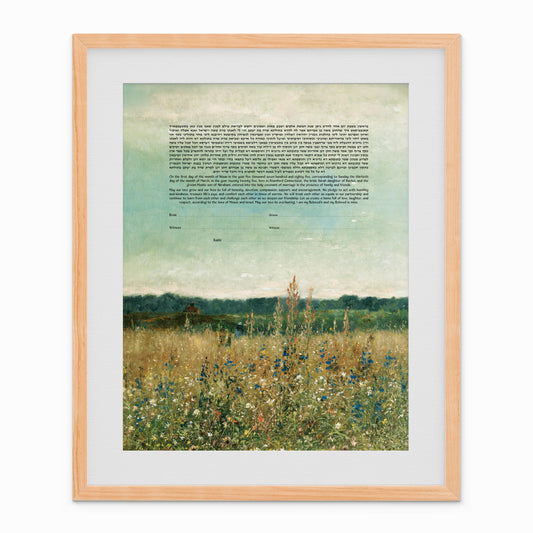
A personalized ketubah includes your names, wedding date, location, selected ceremony wording, and signature lines directly in the printed text. At WeddingKetubah.com, this personalization is included at no additional charge, and you receive a digital proof before printing.
After preparing more than 1,000 ketubahs and working with couples, rabbis, and officiants from many backgrounds, we have developed a careful process for personalizing each ketubah.
-
1Choose the ketubah text
-
2Confirm the wedding and Hebrew dates
-
3Add the English names
-
4Add or transliterate Hebrew names
-
5Choose the signature lines
-
6Review the digital proof
What Is Included With a Personalized Ketubah?
Free personalization includes adding the following information to your selected ketubah text:
- The couple’s names
- Hebrew names, when applicable
- Parents’ names
- Wedding date
- Hebrew date
- Wedding location
- Your selected ceremony text
- Appropriate signature lines
- Reasonable wording and layout adjustments
- A digital proof before printing
Personalization does not include translating newly written vows or fully custom wording from English into Hebrew.
If you write your own English vows and would like them professionally translated into Hebrew, contact us for a separate translation quote. Most couples do not need this service because they choose one of our existing Hebrew and English ketubah texts or provide their custom wording in both languages.
Personalized Ketubah vs. Custom Ketubah Text
Personalized ketubah
A personalized ketubah uses an existing ketubah text with your names, dates, location, and ceremony details added to it. This service is included at no additional charge.
Custom ketubah text
Custom ketubah text means that you provide completely new wording, such as personal vows or text written by your rabbi or officiant. We can usually place customer-provided text into the design, but translation is not included with free personalization.
How Orthodox Ketubah Personalization Is Different
This guide focuses mainly on non-Orthodox personalized ketubahs, which generally allow more flexibility in wording, family names, and signature lines.
Orthodox ketubahs have additional requirements because the traditional Aramaic text, names, dates, and witnesses must follow halacha. The wording is therefore less flexible and should be reviewed and approved by the officiating rabbi.
We will cover how to personalize an Orthodox ketubah in a separate guide.
Step 1: Choose the Text for Your Personalized Ketubah
Your ketubah text should reflect your ceremony, traditions, and relationship.
We offer wording for:
- Orthodox ceremonies
- Conservative ceremonies
- Reform and egalitarian ceremonies
- Interfaith and secular ceremonies
- LGBTQ+ weddings
- Anniversary celebrations and vow renewals
You may begin with one of our standard texts or provide custom wording from your rabbi, officiant, or another source.
Outside text should be sent in an editable Word document or Google Doc so it can be placed accurately into the design.
Step 2: Personalize the Wedding Date and Hebrew Date
The civil wedding date is usually straightforward, but the Hebrew date requires one additional detail: the Hebrew calendar day begins at sunset rather than at midnight.
For that reason, we ask whether the ceremony will take place before or after sunset.
A ceremony held after sunset may fall on the following Hebrew date. We calculate the date based on the information you provide, although couples using traditional wording should also confirm it with their rabbi or officiant.
Step 3: Personalize the English Names
There is no single required format for listing parents’ names in most English ketubah texts. The wording should sound natural to the couple and remain clear to the reader.
When Parents Share a Last Name
The surname does not always need to be repeated.
For example:
“Ashley Friedman, daughter of Jared and Elizabeth”
This creates a cleaner and less repetitive sentence.
When Parents Have Different Last Names
Using each parent’s full name may make the relationship clearer.
For example:
“Ashley Friedman, daughter of Jared Friedman and Elizabeth Stern”
When Family Structures Differ
If one partner’s parents share a surname and the other partner’s parents do not, you may prefer to list all parents by their full individual names for consistency.
We can arrange the names according to your preferences, family relationships, and selected ketubah text.
Step 4: Add Hebrew Names to a Personalized Ketubah
Hebrew names require more care than placing English names into an automatic translation tool.
Hebrew names and phonetic spellings are prepared and reviewed by native Hebrew speakers. We consider the person’s actual Hebrew name, family tradition, preferred pronunciation, and ceremony type.
When Someone Does Not Have a Hebrew Name
For a non-Orthodox ketubah, an English name can often be transliterated phonetically into Hebrew letters.
For example, Michael may be written as מייקל when the goal is to preserve the English pronunciation rather than replace it with a traditional Hebrew equivalent such as מיכאל.
Converts
A convert may use the Hebrew name assigned during the conversion process. The traditional wording can vary and should be confirmed with the officiating rabbi.
Hebrew Names Chosen for the Wedding
In some cases, a rabbi or officiant helps a partner select a Hebrew name before the wedding. We can include that name in the Hebrew text while formatting the parents’ names according to the couple’s chosen wording and ceremony type.
Hebrew-name conventions can vary, particularly in Orthodox and Conservative ketubahs, so the final wording should be confirmed with the officiant.
Step 5: Customize the Ketubah Signature Lines
Signature lines can be adjusted to match the ceremony at no additional charge.
Depending on the ketubah text and the officiant’s instructions, the ketubah may include lines for:
- Two witnesses
- Additional witnesses
- The bride and groom
- Two brides
- Two grooms
- A rabbi
- An officiant
- A cantor
In most cases, it is better to print the role beneath the line, such as “Witness” or “Officiant,” rather than the individual’s name.
This provides flexibility if someone must be replaced at the last minute and prevents the wrong name from being permanently printed on the ketubah.
Orthodox witness requirements and signature lines should always be confirmed with the officiating rabbi.
Step 6: Approve Your Personalized Ketubah Proof
Once the names, dates, wording, and signature lines have been added, we send you a digital proof showing the personalized text inside your selected design.
Review the proof for:
- English and Hebrew names
- Parents’ names
- Wedding and Hebrew dates
- Wedding location
- Ceremony wording
- Signature lines
- Spelling and punctuation
We recommend sharing the proof with your rabbi or officiant, especially when the ketubah contains traditional Hebrew or Aramaic wording.
How to Personalize a Ketubah Before the Wedding
Learning how to personalize a ketubah involves more than entering a few names into a template. Dates, Hebrew names, family structures, ceremony traditions, wording, and signature requirements can all affect the finished document.
Completing these details in advance allows the ketubah to arrive ready for signing, without requiring important information to be written into the artwork during the ceremony.
Personalized Ketubah FAQ
Is ketubah personalization free?
Yes. At WeddingKetubah.com, adding your names, dates, location, selected wording, and signature lines is included at no additional charge.
Does free personalization include Hebrew translation?
No. Translation of newly written English vows or custom wording into Hebrew is a separate service and can be quoted upon request.
Can I provide my own ketubah text?
Yes. You may provide wording from your rabbi, officiant, or another source in an editable Word document or Google Doc.
Can you write an English name in Hebrew letters?
Yes. For many non-Orthodox ketubahs, an English name can be transliterated phonetically into Hebrew and reviewed by a native Hebrew speaker.
Should my rabbi approve the personalized ketubah?
We recommend approval from your rabbi or officiant, especially for Orthodox, Conservative, Hebrew, or Aramaic texts.